
A HEAT-supported study compares two ways of reconstructing 3D human performances: point clouds and Gaussian splats.
Volumetric video is often described as one of the building blocks of future immersive media. It allows objects to be captured in 3D, so viewers can move around them from different angles rather than watching from a fixed camera position.
For theatre presence, that promise is easy to understand. A performer is no longer only a flat image on a screen. They can appear as a 3D presence inside a virtual or mixed-reality space. But there is a practical question behind the experience: how should a moving person be represented once they have been captured? Two common options are point clouds and Gaussian splats. Both can describe a 3D scene, but they do not always behave in the same way, especially when only a small number of cameras are available.
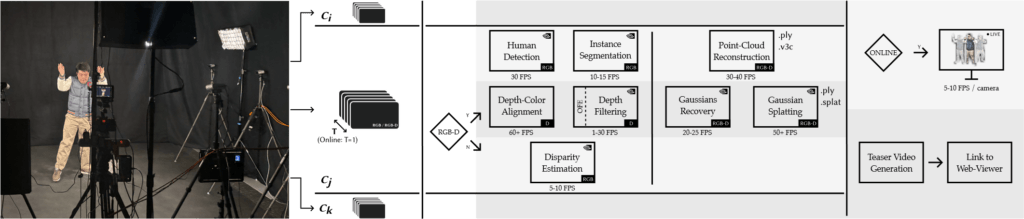
Inside the sparse RGB-D capture setup and reconstruction pipeline used in the study. Image adapted from the paper.
A practical comparison
Researchers at Lucerne University of Applied Sciences and Arts examined this question using a sparse RGB-D capture studio. The team captured a set of human performances and reconstructed them in two ways: once as point clouds and once as Gaussian splats. The same source captures were used for both, allowing the researchers to compare the visual result more fairly.
Gaussian splats have attracted attention because they can produce smooth and view-consistent images, particularly in dense or carefully optimised settings. Point clouds are older and simpler, but they remain widely used because they are robust and relatively predictable.
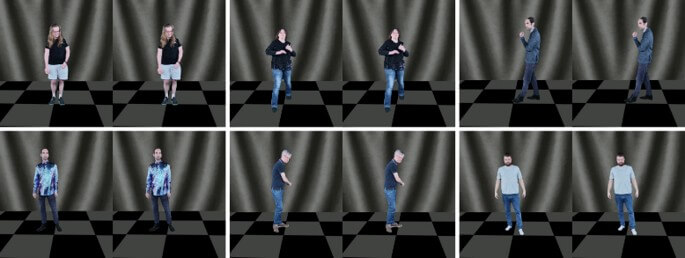
Examples of the paired stimuli shown to participants. The study compared point-cloud and Gaussian-splat reconstructions side by side. Image adapted from the paper.
What viewers preferred
To test visual quality, the researchers ran an online two-alternative forced choice study. In simple terms, participants saw two videos side by side and chose the one they thought looked better. The result was clear. Across 972 decisions from 81 participants, the point-cloud version was chosen 875 times. That is about 90% of all choices. The statistical analysis also supported the finding. The preference for point clouds was not a small or uncertain effect; it was significant across the tested sequences.
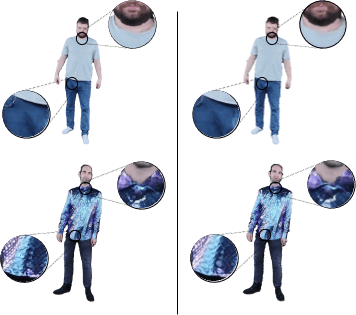
A closer visual comparison between point clouds and Gaussian splats. In this sparse setup, point clouds appeared sharper to viewers. Image adapted from the paper.
Why this matters
The finding does not mean Gaussian splats are worse in general. The study only tested a specific feed-forward Gaussian splat pipeline in a sparse RGB-D capture setup. Other methods, especially those using denser camera layouts or per-scene optimisation, may perform differently. What it does show is more practical. In real production environments, studios may not have large camera arrays or highly controlled capture conditions. They need methods that work reliably with manageable hardware and limited space. In this setting, point clouds remained a strong option. They may be simpler, but they produced reconstructions that viewers judged as clearer and sharper.
For projects such as HEAT, which explore hybrid extended reality technologies for live and virtual experiences, this kind of evidence is important. It helps teams make informed decisions about which 3D representation to use, not only based on technical promise, but also on what viewers actually perceive as better.
The next step is to better understand when Gaussian splats can outperform point clouds, and what kind of capture setup or reconstruction method they need to do so. For now, the message is simple: in sparse volumetric capture, newer is not always better and point clouds still have a clear role to play.
Source: Croci, Charisoudis, Lam and Smolic, “Evaluation of Dynamic Gaussian Splats versus Point Clouds for Sparse Captures”, EUSIPCO 2026 paper draft. Figures adapted from the paper for blog use.